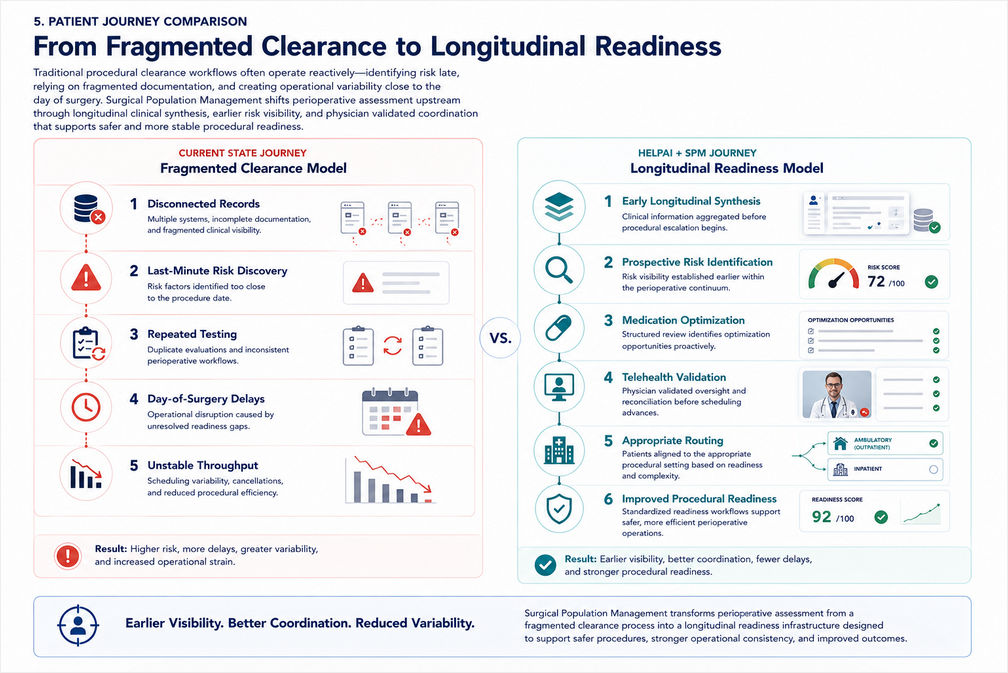
Traditional procedural clearance models often rely on fragmented documentation, late-stage risk identification, and inconsistent perioperative coordination that can create delays, operational disruption, and variability close to the day of surgery.
Surgical Population Management transforms the patient journey into a longitudinal readiness model built around earlier clinical visibility, prospective risk identification, standardized assessment pathways, and physician validated coordination. By synthesizing patient information upstream in the perioperative continuum, healthcare organizations can identify optimization opportunities earlier, support more appropriate procedural routing, and improve readiness consistency before procedural escalation occurs.
The result is a more coordinated perioperative experience that supports safer procedural readiness, stronger operational alignment, reduced variability, and improved continuity across the procedural care journey.