
Divi Real Estate Group
Structured Clinical Assessment Before the Encounter
HelpAI operationalizes Surgical Population Management through a structured, longitudinal workflow that begins before the day of surgery. By synthesizing patient data, identifying risk earlier, and supporting physician validated decision making, the model creates a more coordinated and standardized approach to procedural readiness.
Schedule a Demo
Explore the SPM Model
Clinical Overview
contact us
Surgical Population Management Workflow
The preprocedural assessment process should function as a longitudinal clinical coordination model — not a last-minute administrative task.
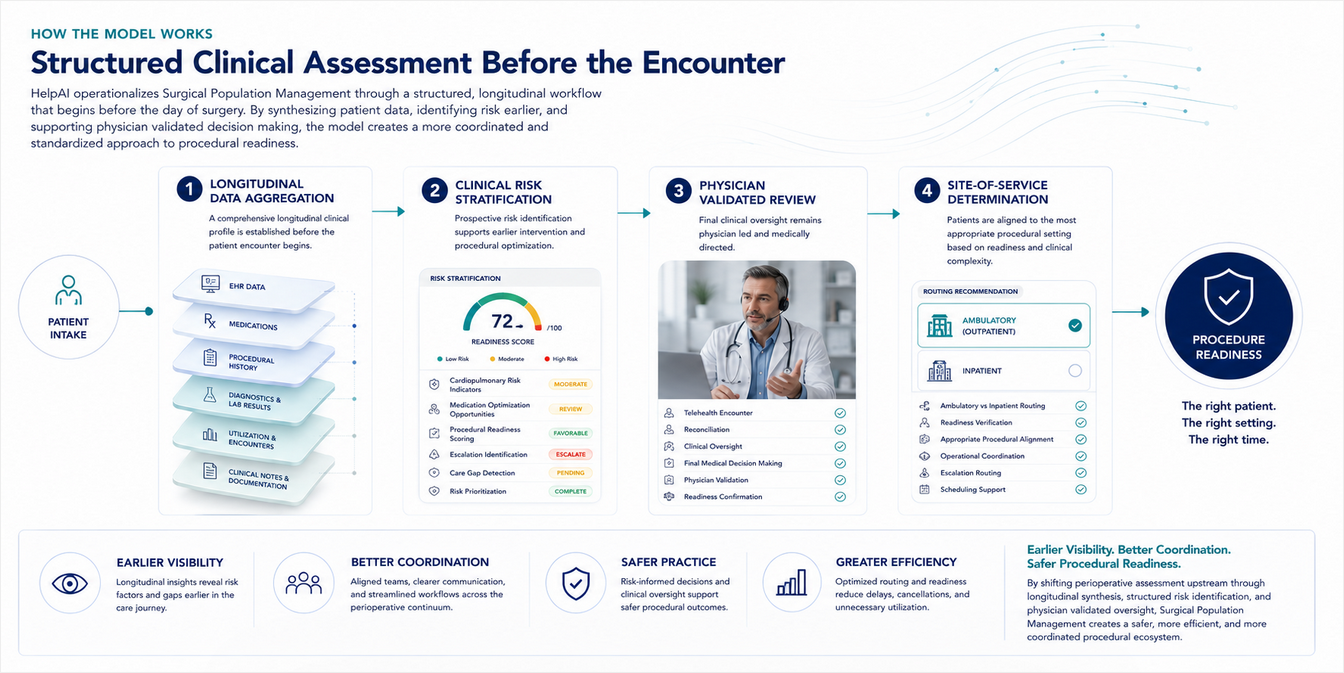
STEP 1 Longitudinal Data Aggregation - A comprehensive longitudinal clinical profile is established before the patient encounter begins.
HelpAI retrieves and synthesizes information across the perioperative continuum to establish a structured clinical readiness profile. Rather than relying on fragmented documentation or isolated evaluations, the model creates a unified longitudinal view of the patient before procedural planning advances.
- EHR retrieval
- Procedural history
- Medication review
- Chronic condition synthesis
- Prior utilization analysis
- Clinical documentation aggregation
STEP 2 Clinical Risk Stratification - Prospective risk identification supports earlier intervention and procedural optimization.
Clinical indicators are evaluated using standardized perioperative assessment logic to identify risk factors, optimization opportunities, and escalation pathways before procedural disruption occurs.
- Cardiopulmonary risk indicators
- Medication optimization opportunities
- Procedural readiness scoring
- Escalation identification
- Care gap detection
- Risk prioritization
STEP 3 Physician Validated Review - Final clinical oversight remains physician led and medically directed.
Structured telehealth review and physician validated assessment support reconciliation, oversight, and final medical decision making prior to procedural advancement.
- Telehealth encounter
- Reconciliation
- Clinical oversight
- Final medical decision making
- Physician validation
- Readiness confirmation
STEP 4 Site-of-Service Determination Patients are aligned to the most appropriate procedural setting based on readiness and clinical complexity.
The final readiness profile supports procedural routing decisions that align patient complexity, operational capability, and perioperative safety considerations.
- Ambulatory vs inpatient routing
- Readiness verification
- Appropriate procedural alignment
- Operational coordination
- Escalation routing
- Scheduling support
Earlier Visibility. Better Coordination. Safer Procedural Readiness.
By shifting perioperative assessment upstream through longitudinal synthesis, structured risk identification, and physician validated oversight, Surgical Population Management creates a safer, more efficient, and more coordinated procedural ecosystem.